The new campaign needs a place to catch your breath. Lexington Market is now a safe stop you can reach from the city map: enter through the barricades, walk the hall with both survivors, and choose where to spend the money earned out in the streets.
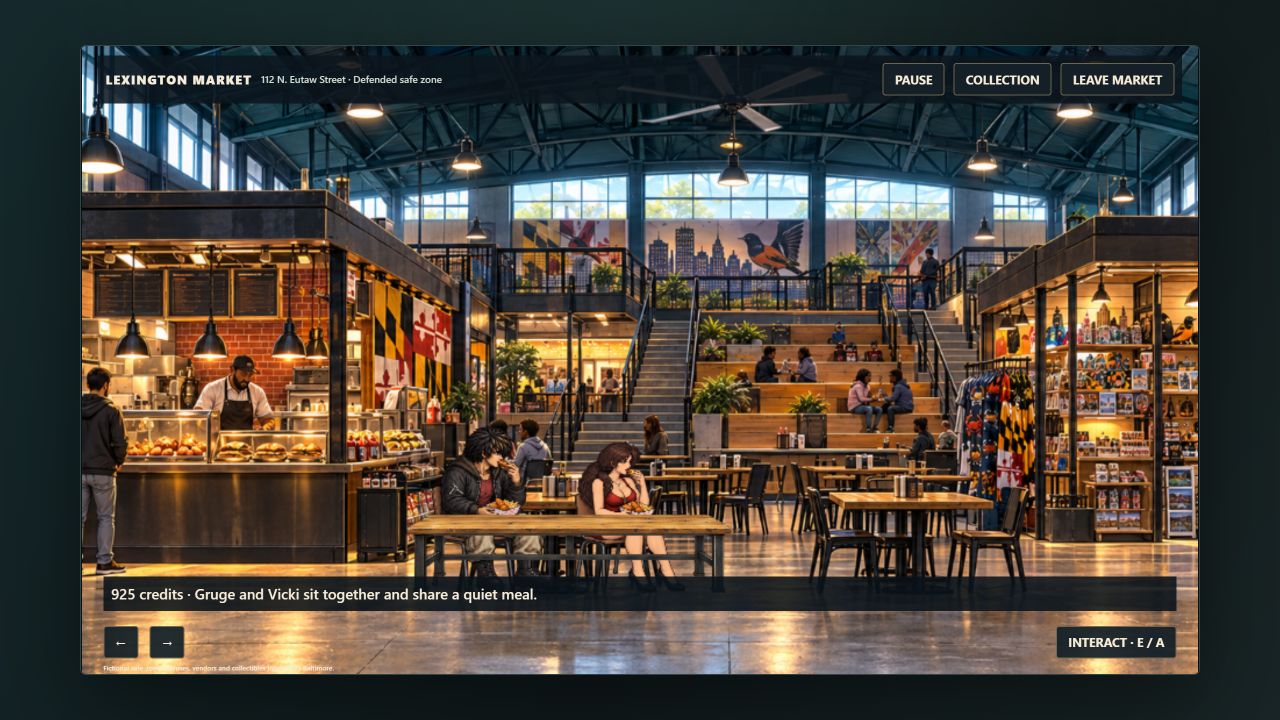
The setting follows the current market at 112 North Eutaw Street. Its map marker sits on the real building footprint and reads “Guns are available here.” The new native ImageGen exterior and interior use the completed market’s architectural photographs as references: gray metal roof forms, brick and glass entrances, dark steel trusses, broad communal steps, and a hall of food counters. The military counter and outbreak barricades belong to the game’s fiction.
Inside, Gruge and Vicki remain playable sprites. Walk to the food stall, table, military counter, souvenir stall or exit; the controls support keyboard, controller and touch. Opening the market pauses the current mission. Leaving it brings you back to the paused game, so a supply trip does not restart a battle or move your survivors to a different stage.
Order a chicken box for 75 credits or a cheesesteak for 65. Choose salt, pepper and ketchup, then carry the order to the table and sit down to eat. The two meals have distinct painted food and seated scenes. Finishing a chicken box restores up to 35 health to each living survivor; a cheesesteak restores up to 30. A paid order can wait until you are ready to eat, and it heals only once. The chicken box and cheesesteak are grounded in the market’s real food offerings, including Connie’s and Ronny’s Combo; the game’s stall, prices and meal interactions are fictional.
The military counter sells and equips weapons, with separate finite ammunition reserves for pistols, rifles, SMGs and shotguns, plus grenade packs. You can inspect your current rounds before buying. Equipment, ammunition, purchase receipts and credits survive returning to the title and choosing Continue. Everything uses earned game credits.
Those credits now connect to people in the world. Civilians appear along the playable routes, and successful rescues pay into the wallet once per person. Returning to a cleared route cannot turn the same rescue into an unlimited source of money. You can use the earnings to keep both heroes supplied or bring home something from the city they are trying to save.
The souvenir stall has three textured 3D miniatures: Baltimore’s pentagonal World Trade Center, the Washington Monument’s column and statue, and Fort McHenry’s star fort. Open a collectible to rotate it and zoom in, using a pointer, buttons or controller. Each model uses native ImageGen textures on real three-dimensional geometry. Purchased souvenirs stay in your saved collection. These are ordinary collectibles, separate from the campaign’s fictional power relics.
The shapes follow their Baltimore landmarks: the World Trade Center on the Inner Harbor, Mount Vernon’s Washington Monument, and Fort McHenry. They give this quiet corner of the game a little of the city’s history without turning every object into an alien artifact.
This market joins the first campaign expansion: Battery Avenue, the mayor encounter, the Convention Center approach and HQ, and the B&O Roundhouse’s first relic. The wider city roster, remaining historic-anchor missions and World Trade Center finale are still in development. Read the campaign route update for what is playable and what comes next.